Control SAP access. Reduce SoD risk. Improve audit readiness.
Introduction
SAP security becomes difficult as the business grows.
New users join. Employees change roles. Business units add new processes. SAP roles change over time. Temporary access becomes permanent. Custom transactions increase. Fiori applications add another access layer.
The result is often the same: users have more access than they need, roles become difficult to maintain, and the security team spends more time finding problems than preventing them.
This is where Segregation of Duties (SoD) and Role-Based Access Control (RBAC) become critical.
TRUSPEQ Custom GRC Solution provides a practical approach to identify access risks, clean SAP roles, control elevated access, and improve user provisioning without adding a large and complex GRC platform.
The solution combines SoD Risk Analysis, Role Cleanup Automation, User Provisioning, Elevated Access Management, SAP Security Analysis, and Role Automation.
The SAP security problem is often not access. It is excess access.
Most companies start with a simple objective:
Give each employee the SAP access required to do the job.
Over time, this becomes difficult.
A user can receive several roles because of job changes, temporary assignments, support requirements, or copied access from another employee. Security teams can also create new roles when an existing role does not meet a business requirement.
After several years, the SAP authorization model can become complex.
The business may not know:
- Which users have excessive access.
- Which roles contain SoD conflicts.
- Which transactions users actually execute.
- Which roles are no longer required.
- Which critical transactions are available to too many users.
- Whether emergency access is used only for the approved purpose.
- Whether a new role assignment will create an SoD conflict.
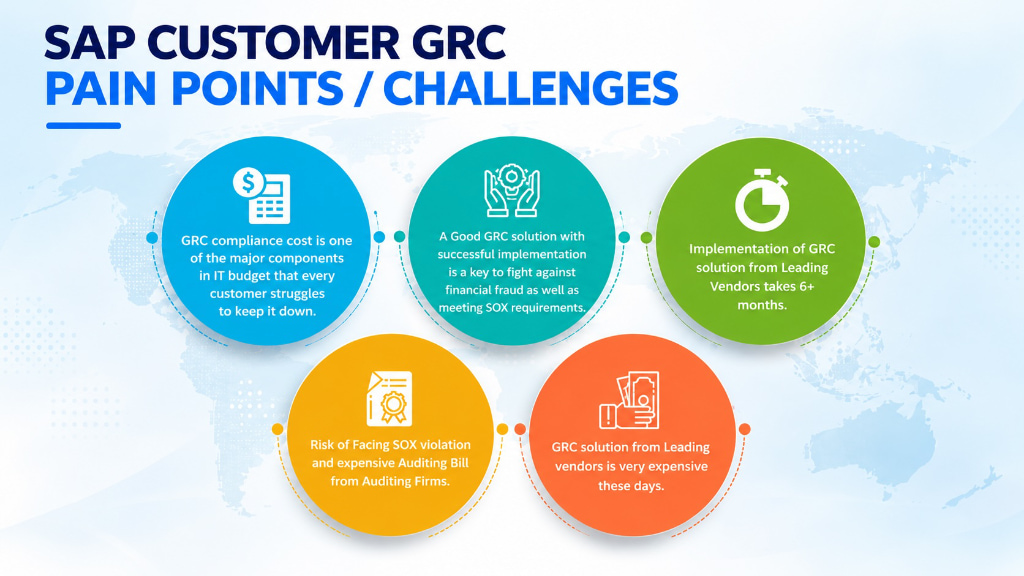
High GRC compliance cost, expensive audit findings, long implementation cycles, and poorly designed SAP roles are common challenges across landscapes that needs a viablke long term solution
Why Segregation of Duties becomes difficult
SoD protects the organization from situations where one person can perform conflicting business activities.
For example, a user should normally not be able to:
Create a vendor + change vendor bank details + process an invoice + make the payment.
The individual activities can be valid. The risk comes from the combination.
This is why SoD analysis must look beyond a list of transactions.
It must understand:
- User access
- Role access
- Transaction combinations
- Authorization objects
- Business processes
- Critical access
- Mitigating controls
TRUSPEQ Custom GRC Solution analyzes SoD risks against SAP users and roles based on their access permissions. The solution can also analyze risk at transaction code and authorization-object level.
RBAC creates another challenge
Role-Based Access Control sounds simple:
Job responsibility → SAP role → required access.
In practice, SAP roles often develop over many years.
A company can have hundreds or thousands of custom roles. Similar transactions can exist in many roles. Old transactions can remain after business processes change. Users can receive several overlapping roles.
This creates three problems.
1. Role proliferation
The number of roles continues to increase.
Security teams then find it difficult to understand why a role exists and who should use it.
2. Excess access
A role can contain transactions that are not required for the user’s current job.
The user can therefore have valid access for one activity and unnecessary access for several other activities.
3. SoD conflicts inside the role model
If conflicting activities exist inside roles, SoD problems will continue even when user provisioning is controlled.
A good RBAC design must therefore address both who receives access and how the roles are designed.
The TRUSPEQ security design approach supports job-based and task-based role models. Task-based design can separate access into General, Display, Functional, and Control Point access. This structure helps create smaller and more controlled access units.
From periodic audit to continuous access control
Many organizations review SAP access only during an audit.
This creates a reactive model:
Audit starts → Risks are found → Security team creates reports → Business validates risks → Roles are changed → Audit closes.
A few months later, new access changes can create the same risks again.
TRUSPEQ Custom GRC Solution changes this model.
The objective is to identify risk before it becomes an audit issue.
How TRUSPEQ Custom GRC Solution works
The solution uses SAP security and usage data across the SAP landscape.
It can analyze information such as:
- SAP users
- SAP roles
- Assigned transactions
- Executed transactions
- Dialog logs
- Audit logs
- Authorization objects
- Customer-specific risk rules
The solution can use a standard risk ruleset together with the customer’s own risk rules. It then identifies risky users and risky roles, simulates changes, and supports role cleanup.
This creates a simple operating cycle:
Discover → Analyze → Simulate → Remediate → Monitor
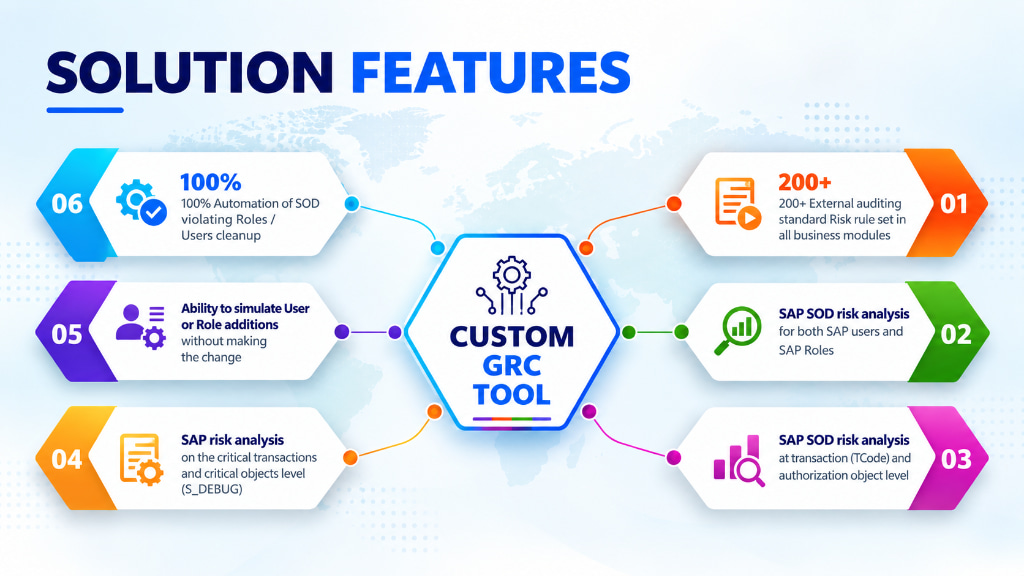
1. SoD Risk Analysis
The SoD Analyzer identifies conflicting access at both user and role level.
Security teams can analyze:
- SoD conflicts
- Sensitive access
- Critical transactions
- Critical authorization objects
- Business-process risks
- Risk users
- Risk roles
The solution supports for multiple standard audit risk rules across business modules, together with customer-specific rules.
This gives the security team a structured risk baseline instead of depending only on spreadsheets and manual checks.
2. SoD Role Cleanup Automation
Finding a problem is only the first step.
The larger effort is often remediation.
The TRUSPEQ SoD Risk Role Cleaner is designed to help identify and remove risky access from roles and users. The objective is to clean the current environment and reduce the chance of the same risk being introduced again.
This can help security teams answer a difficult question:
Which access should we remove without affecting the user’s business work?
Usage information becomes important here.
Instead of making decisions only from assigned access, teams can also review executed transactions.
3. Access Simulation before provisioning
A common security problem happens after approval.
A manager approves a new role because the role itself appears valid. However, when the role is combined with the user’s existing roles, a new SoD conflict appears.
TRUSPEQ Custom GRC Solution supports simulation of users and roles before the change is made.
This allows security teams to assess the risk before access reaches production.
4. User Provisioning
Access requests must be fast, but speed cannot remove control.
TRUSPEQ Custom GRC Solution supports automated user provisioning so that users can receive the access required for their work while the organization maintains control over inappropriate access.
The target operating model is simple:
Request → Risk check → Approval → Provisioning → Monitoring
5. Elevated Access Management
SAP support teams sometimes require powerful production access.
This access can be necessary during:
- Critical incidents
- Month-end activities
- Production defects
- Emergency configuration
- Business-critical support
Permanent privileged access creates unnecessary risk.
The TRUSPEQ Elevated Access capability provides temporary elevated access for a defined period. Executed transaction codes can then be tracked and compared with the original request.
This provides better control over emergency and firefighter-type access.
6. SAP Security and Role Automation
SAP security is not only about SoD.
The authorization model itself must remain clean.
TRUSPEQ supports role analysis and role automation to help customers move toward a structured RBAC model.
A well-designed role model can combine:
Business Role → Task Roles → Transactions/Fiori Apps → Organizational Restrictions
The solution also supports single/task/master/derived roles and composite/business roles for access provisioning.
This provides a stronger base for long-term SAP security governance.
A practical approach to SAP security redesign
Technology alone does not solve SAP access problems.
Roles, business processes, controls, and governance must work together.
TRUSPEQ uses a four-stage approach.
Assess
Review the current SAP security and SoD position.
We identify:
- Excess access
- SoD conflicts
- Sensitive access
- Critical access
- Role duplication
- Poor role design
- Control gaps
- Differences across business units
Design
Define the target security and RBAC model.
The design considers business responsibilities, SoD requirements, organization structure, Fiori access, transaction access, and existing controls.
Compliance is built into the design instead of being added after role creation.
Construct and Remediate
Clean existing roles or build the required target roles.
This can include:
- Removal of unused access
- Removal of risky transactions
- Role consolidation
- Task-role design
- Business-role design
- Organizational restrictions
- SoD remediation
- Mitigation design
Implement and Operate
Deploy the approved security design and establish ongoing governance.
TRUSPEQ’s presentation defines this lifecycle as Assess, Design, Construct, and Implement & Operate.
Built for the SAP landscape
TRUSPEQ Custom GRC Solution is designed as an ABAP-based solution.
It can operate within the SAP landscape and can consolidate information for central reporting. The presentation also describes support for extracting data from SAP systems into a central system.
The solution architecture supports an SAP transport path across:
Development → Quality → Production
- The available components include:
- SoD Analyzer
- SoD Cleanup Automation
- Elevated Access
- SAP Security Analyzer
- Role Automation Tool AuditBOT Presentation – GRC and…
This approach can reduce the infrastructure and operational overhead associated with a separate large GRC platform.
What the customer gains
TRUSPEQ Custom GRC Solution helps SAP customers move from manual access reviews to a more controlled security model.
The main benefits are:
- Identify SoD conflicts across SAP users and roles.
- Detect sensitive and critical access.
- Analyze risk at transaction and authorization-object level.
- Use standard and customer-specific risk rules.
- Simulate access before a role or user change.
- Remove unnecessary access from users and roles.
- Improve RBAC design.
- Control temporary elevated access.
- Improve user provisioning.
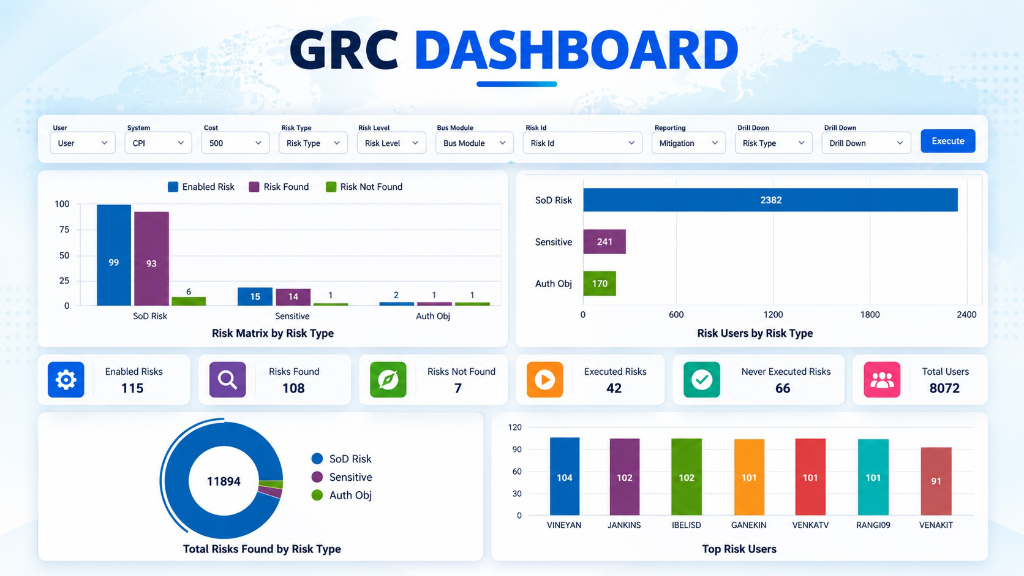
- Provide dashboards and detailed audit reports.
- Reduce manual security analysis.
- Improve audit readiness.
- Support continuous access governance.
From thousands of SAP roles to clear business access
The real objective of SAP security is not to create more roles.
It is to give every user:
the right access, for the right job, in the right system, for the right period, with the right control.
TRUSPEQ Custom GRC Solution brings SoD analysis, role cleanup, RBAC, access simulation, provisioning, and elevated access control into one practical framework.
For organizations that already run SAP but do not want the complexity and cost of a large traditional GRC implementation, it provides another path to stronger access governance.
And for organizations preparing for S/4HANA, RISE with SAP, security redesign, or an audit, it can help clean the current environment before access risk moves into the new landscape.
Start with a SAP Security & SoD Assessment
TRUSPEQ can begin with an assessment of your current SAP authorization landscape.
We can help answer five questions:
- Where are our highest SoD risks?
- Which users have more access than their job requires?
- Which SAP roles create the most security risk?
- Which unused or duplicate access can we remove?
- How should we redesign RBAC for the future SAP landscape?
The result is not only another risk report.
It is a practical roadmap to analyze, clean, redesign, automate, and continuously control SAP access.